// News
Gastil advocates new ways to engage the public for a stronger and better democracy
The researcher opened the IX INCT.DD Congress with reflections on the challenges and opportunities for democracy amid major digital transformations.
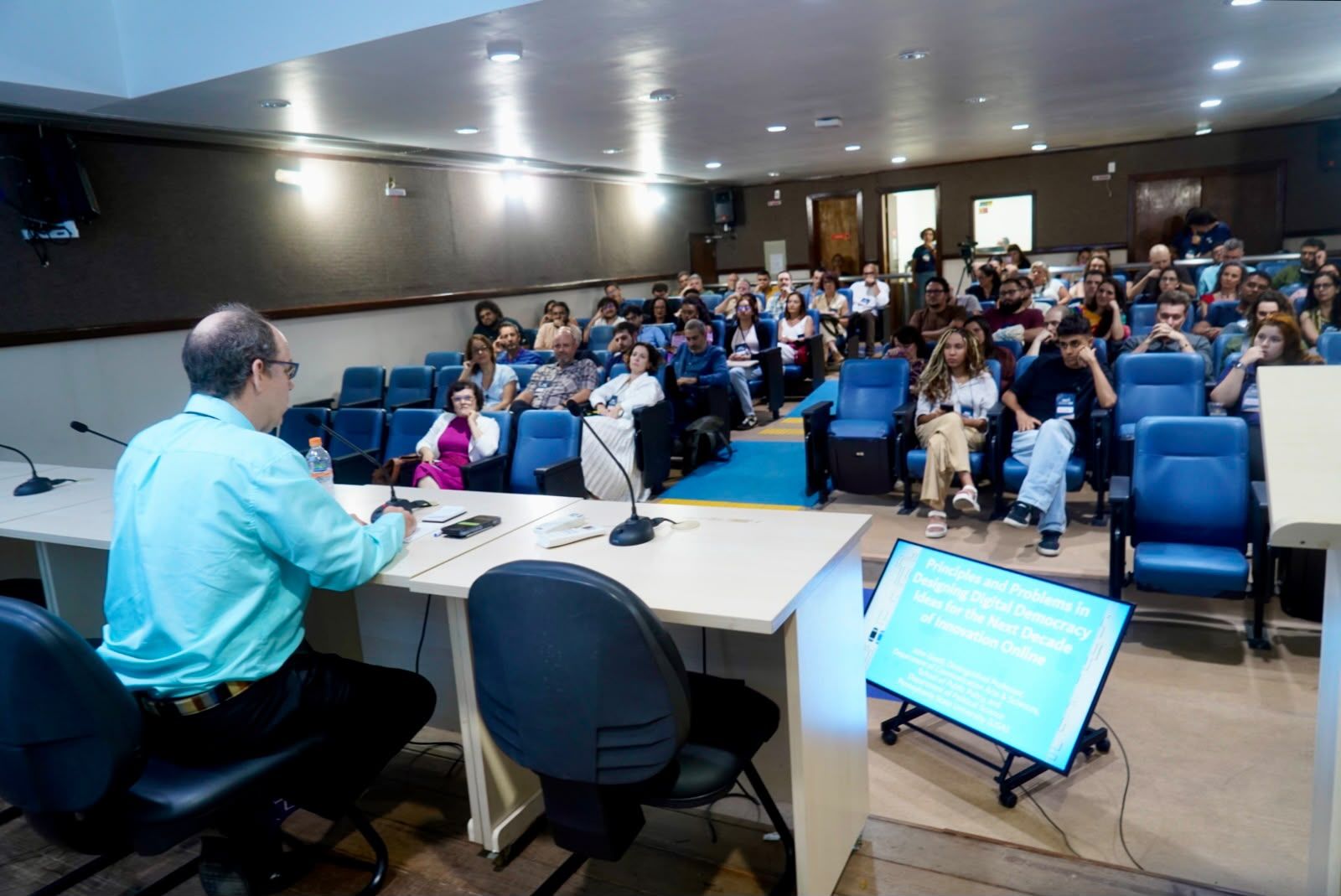
The internet was once surrounded by promises of expanding public participation, bringing citizens closer to governments, and making political debate more accessible. Some of these expectations remain. Others have encountered problems that now permeate life on digital platforms: disinformation, bot activity, extremist discourse, and inequalities in access to and use of technology.
It was against this backdrop — the contrast between what was envisioned for the internet and what it has become — that Professor John Gastil, from Pennsylvania State University, United States, delivered the opening keynote at the IX Brazilian Congress on Digital Democracy, Government, and Digital Politics, organized by the National Institute of Science and Technology for Digital Democracy (INCT.DD). The conference took place on Tuesday (10) at the School of Communication of the Federal University of Bahia (UFBA), in Salvador.
Under the title Principles and Problems in Designing Digital Democracy: Ideas for the Next Decade of Innovation Online, Gastil presented reflections on the principles and challenges involved in building more democratic digital environments.
Among the issues highlighted were the concentration of power in commercial platforms, the declining credibility of knowledge-producing institutions, and a business model that can encourage the spread of extremism and disinformation. The discussion also addressed the concept of the Democracy Machine, a research project focused on developing innovations in online deliberation.
One of the professor’s proposals is to expand the use of gamification in public debate to encourage deliberation. Gastil argues that incorporating game elements can help people participate more actively and effectively in debates and collective discussions. According to him, different types of human motivation can be activated through different game mechanics.
The questions raised by the professor set the tone for the congress discussions, which, over the coming days, will reflect on the impacts of digital transformations on institutions, information circulation, and the exercise of democracy.
By Luanda Costa
Photo: Eduardo Vasconcelos