// News
INCT.DD launches book on media consumption and democracy in Brazil
Publication presents findings from longitudinal research conducted by INCT.DD in 2024 and 2025, tracking changes in Brazilians’ media consumption habits and political behavior.
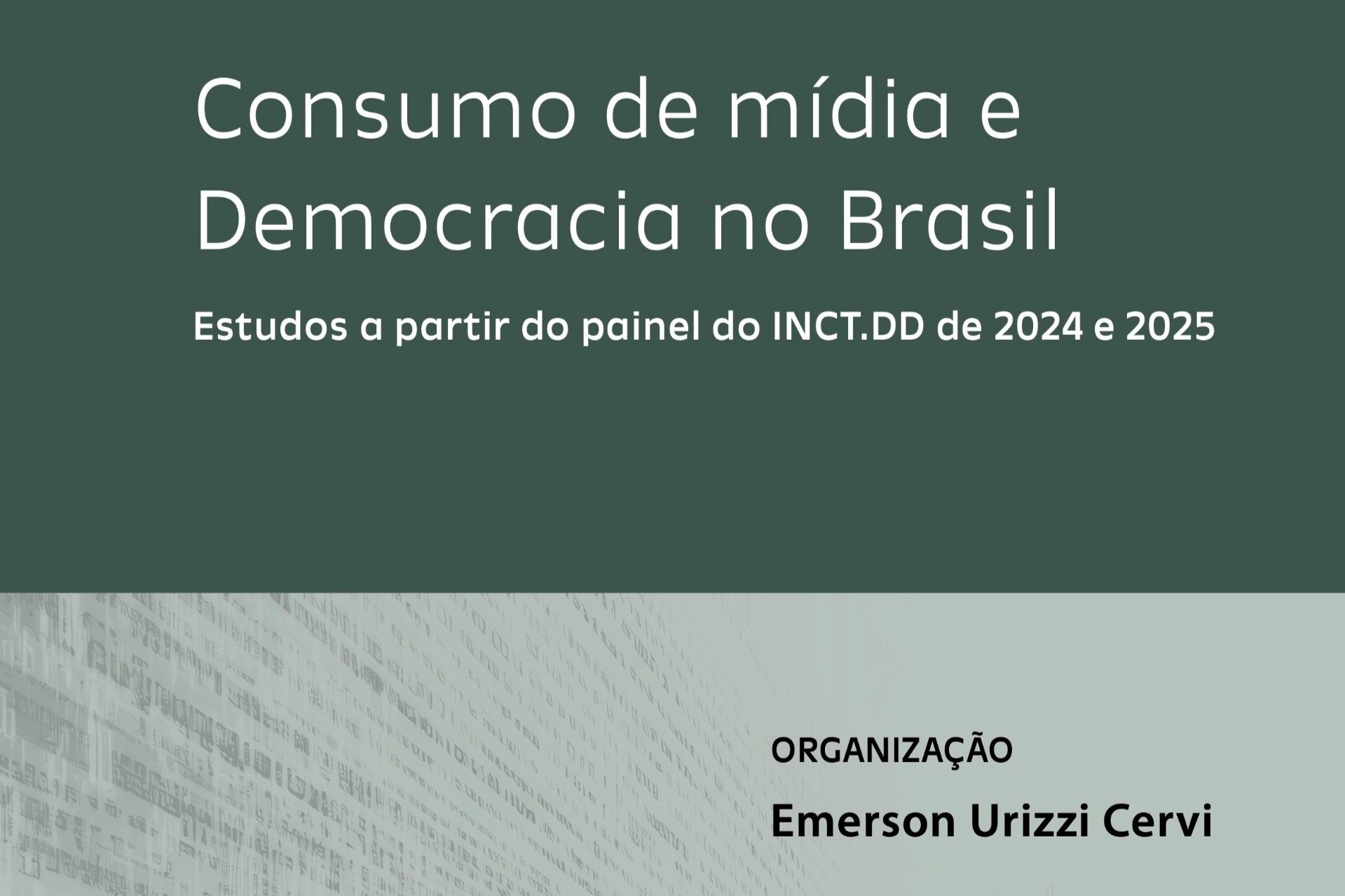
The National Institute of Science and Technology for Digital Democracy (INCT.DD) launches the book Media Consumption and Democracy in Brazil: Studies Based on the INCT.DD Panel of 2024 and 2025, edited by researcher Emerson Urizzi Cervi. The publication brings together six studies conducted by researchers affiliated with the Institute and examines the relationships between information consumption, trust in institutions, disinformation, religion, and political behavior in Brazil.
The studies draw on data from a national panel representative of Brazil’s adult population, launched by INCT.DD in 2024. The research was conducted in two waves: the first during that year’s election campaign and the second in the post-election period, in 2025. This initiative makes it possible to follow the same individuals over time, identifying continuities and changes in media consumption patterns and political attitudes.
The panel addresses a gap in communication and political studies. While cross-sectional surveys identify prevailing trends and behaviors in society at a given moment, following the same participants makes it possible to observe changes at the individual level. In this way, the book contributes to understanding how different forms of access to and consumption of political information relate to values, perceptions, and democratic behaviors in both electoral and non-electoral contexts.
The topics covered include factors influencing trust in journalism; Brazilians’ perceptions of news sharing and disinformation; trust in political institutions during and after elections; the relationship between religion and media consumption among young people; the association between information consumption, social distance, and perceptions of the effects of fake news; and the so-called Dunning-Kruger (DK) effect in Brazilian politics, particularly its relationship with radicalism and anti-democratic behavior.
In addition to Emerson Urizzi Cervi, who authored one of the chapters, the studies are co-authored by Frederico Oliveira, Magali Moser, Eurico Oliveira Matos Neto, Denisson da Silva Santos, Fernanda Cavassana, Robert Pinheiro, Samuel Barros, and Fiorenza Zandonade Carnielli.
Access the publication by CLICKING HERE.